Salt Air Damage to Balcony Railings: What Salt Does to Each Material
Salt lands on every balcony near Tampa Bay, but it attacks each material differently. This guide covers aluminum, stainless steel, glass and concrete, what the damage looks like, and where cleaning stops.


Salt air balcony railing damage starts with chemistry: chloride from sea salt breaks down the protective films on metal and soaks into concrete. Aluminum pits, stainless steel stains brown, painted steel rusts, and salt that reaches the rebar inside a slab cracks the concrete from within. Glass only collects a film you can wash off. How fast any of it happens depends most on how close you live to the water.
How does salt air reach a balcony railing?
Wind lifts spray off the water, and the droplets dry into salt crystals on whatever they land on. The direction your balcony faces changes the dose, not whether it gets one. NASA runs a beach test site at Kennedy Space Center that it describes as having higher atmospheric corrosion rates than any other known test site in the United States, and its numbers show how fast the dose falls with distance.
In a 2023 study, steel panels 150 feet from the Atlantic lost 0.295 millimeters a year; panels about 600 feet inland lost 0.023. Farther inland the numbers barely moved, and a site five miles away still recorded salt.
Tampa Bay is calmer than the Atlantic, but it is salt water. The Tampa Bay Estuary Program puts Lower Tampa Bay at 25 to 38 parts per thousand and Hillsborough Bay, which Harbour Island faces, at 15 to 30. A tower across the park from the water on Beach Drive sits in the band where the dose is highest.
| Distance from the Atlantic | Steel corrosion, per year | Salt deposited, per day |
|---|---|---|
| 150 feet (45 m) | 0.295 mm | 982 mg per square meter |
| 600 feet (183 m) | 0.023 mm | 70.6 mg per square meter |
| 0.75 miles (1,207 m) | 0.026 mm | 57.1 mg per square meter |
| 5 miles (8,047 m) | 0.014 mm | 23.1 mg per square meter |
Uncovered carbon steel panels at Kennedy Space Center, NASA, 2023.
What does salt do to an aluminum railing?
Salt breaks down the thin film that keeps aluminum from corroding, and the metal starts to pit. Aluminum grows that oxide film by itself the moment it meets air. Chloride punctures it in small spots, and each spot becomes a pit.
However, this oxide layer can breakdown in the presence of aggressive anions, such as the halide and perchlorate ions, resulting in the pitting corrosion of the aluminum.
Source: NASA, Corrosion on Mars (NASA/TP-2019-220238), Kennedy Space CenterA powder-coated or painted aluminum rail has a second defense in its coating, and salt goes after the gaps in it. Salt water that gets in through a chip or scratch can spread under the paint in thin threads, a pattern the Aluminum Association calls filiform corrosion and describes as more common in coastal areas. Look at the underside of the top rail and around every screw and bracket, where a chip goes unnoticed longest.
What does salt do to a stainless steel railing?
Salt stains stainless steel brown on the surface, and the stain is cosmetic. The Australian Stainless Steel Development Association calls it tea staining, names sea salt on the surface as one of its major causes, and says it does not affect the structural integrity or the lifetime of the materials.
The grade matters. Grade 316 contains molybdenum and resists chloride better than grade 304, which is why the same association recommends 316 as a minimum within about five kilometers of the surf. If you do not know which grade your building used, the original specifications in the association’s records may say. Either grade stays cleaner with regular washing, because washing removes the salt before it can stain.
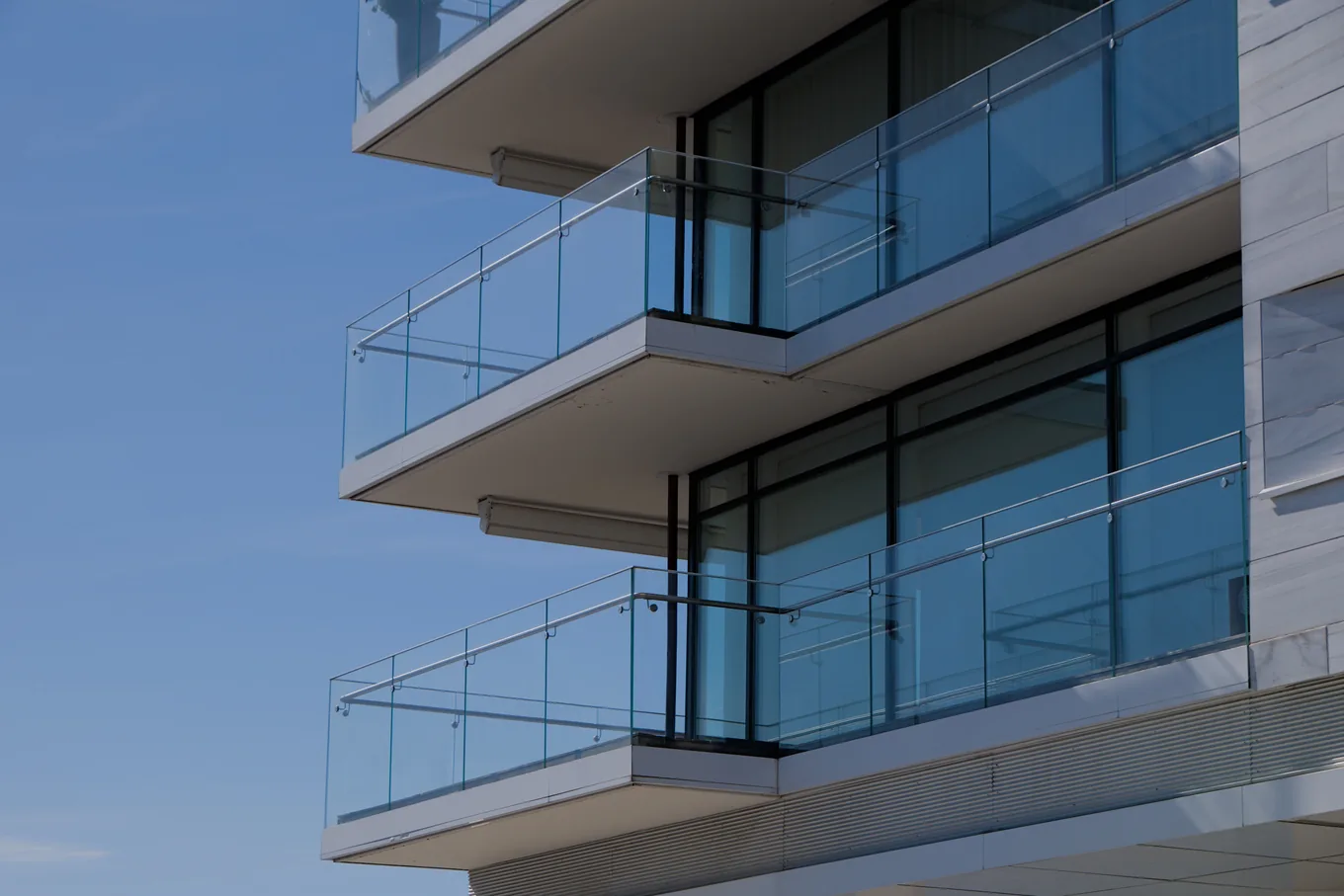
Can salt air damage a glass balcony railing?
Salt does not etch glass. It dries on the panel as a white film or spots, and cleaning takes it off. Glass maker Pilkington notes that coastal spray leaves salt crystals stuck even to its self-cleaning glass.
Glass can be damaged for good by other things. Vitro, another glass maker, warns that rain running through concrete can leach alkaline material and deposit it on glass, sometimes causing staining and etching. On a balcony, that runoff comes off the slab edge above, so check the lower part of each panel first. The National Glass Association keeps razor blades and metal scrapers out of routine cleaning, because they scratch.
What does salt do to the concrete and rebar?
Salt that soaks into a concrete slab can reach the steel reinforcing bars inside and make them rust. Rust takes up several times the volume of the steel it came from, so it pushes outward until the concrete cracks and pieces break away, which engineers call spalling.
In both cases (deicing salts and marine exposure), the deterioration is a consequence of the aggressive nature of the chloride ion.
Source: Federal Highway Administration, FHWA-HRT-04-093, Corrosion and Corrosion Control of Reinforced Concrete StructuresCracks, rust stains running from them and loose pieces of the slab edge are structural problems that cleaning cannot fix. A balcony slab is usually part of the common elements, which section 718.113 of the Florida Statutes puts on the association to maintain unless the declaration gives that job to the owner. Report what you see to the manager in writing.
This is general information about how Florida condominium documents usually work, not legal advice. Your declaration governs, and a Florida community association attorney can read it with you.
What does salt damage look like, stage by stage?
Salt damage moves through recognizable stages, and the first two are the ones cleaning still reverses:
- Film. Glass looks hazy and metal feels gritty under a damp cloth. Fresh water takes it off.
- Surface stains. Brown tea staining on stainless steel, and white mineral spots on glass.
- Coating failure. Bubbles or thread-like lines under the paint on aluminum, spreading from chips.
- Metal loss. Pits in bare aluminum, orange rust through painted steel.
- Concrete damage. Cracks and spalling where salt has reached the rebar.
No published source gives a reliable number of months between stages. The pace depends on distance from the water, the material, and how often rain or a person rinses the surface. NASA did find a seasonal pattern on the Florida coast: corrosion ran highest in winter, when surfaces stay wet longer and less rain washes the salt away.
Which parts of a balcony collect the most salt?
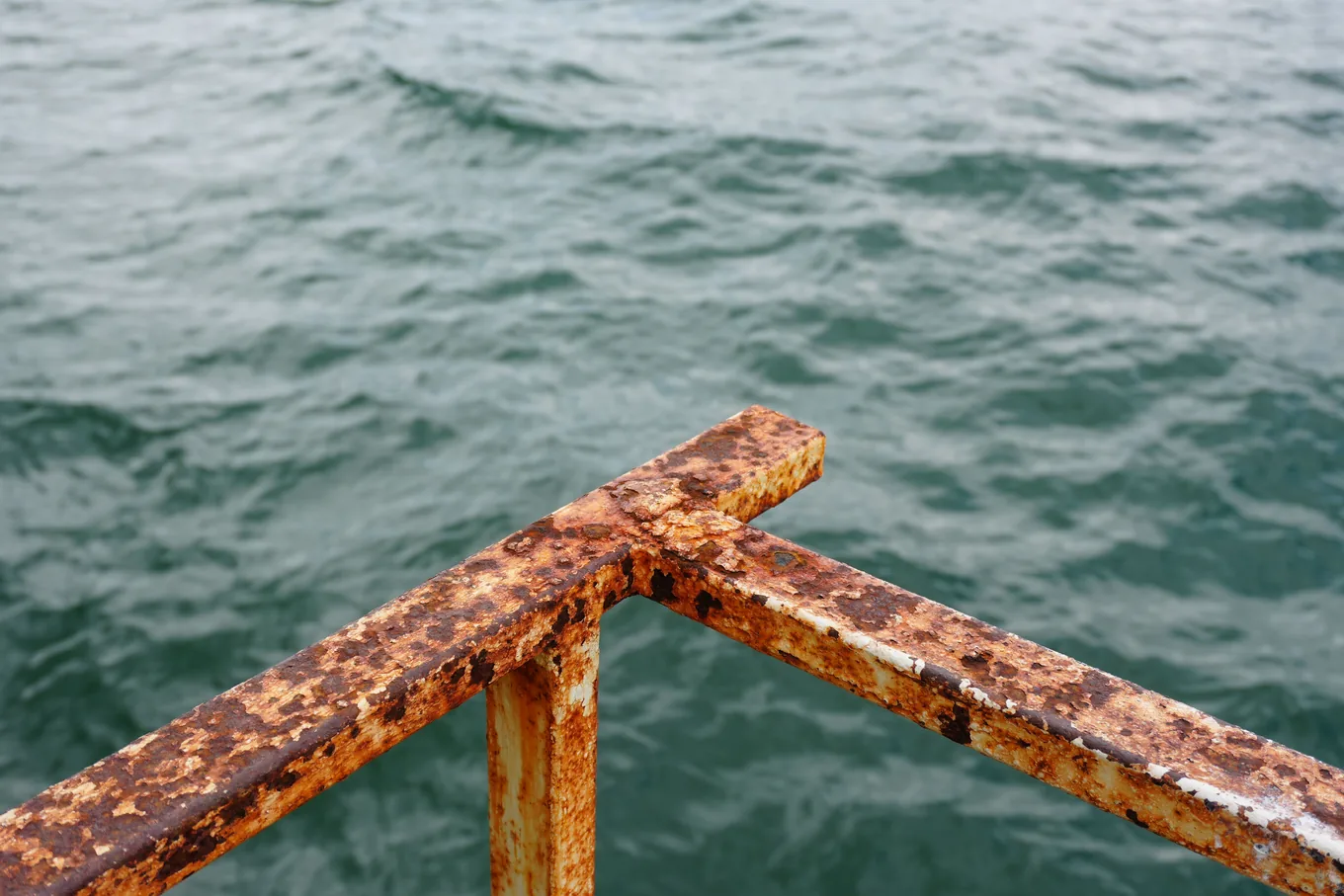
The parts rain never rinses collect the most salt. Wind carries salt into sheltered corners, but the rain that would wash it off never reaches them.
Sheltered areas can be more at risk of coating degradation than exposed areas. This is because wind-blown salt and other pollutants may adhere to the surface and will not be cleaned away with rainfall.
Source: AkzoNobel Interpon, Guidance Note 6: Cleaning and Maintenance of Powder Coated Architectural ComponentsOn a balcony that means the underside of the top rail, the rail and glass tucked under the balcony above, the ceiling, the slider track and the back corners of the slab. A fully enclosed surface is a different case: at NASA’s beach site, steel panels shielded from rain and wind corroded about a third as fast as open ones. You may hear that high floors take the most salt; we found no published measurement showing it. Whether your tower is in St. Petersburg or Tampa, check the sheltered parts first.
Not sure whether your railing needs a wash or a repair? Text us a photo and we will tell you which side of that line it is on.
Text a photo of your railHow does salt damage connect to milestone inspections?
Corroded concrete and steel are what Florida’s milestone inspections exist to find. Under section 553.899, a residential condo tower gets its first structural inspection in the year it turns 30 and another every ten years after, and the local building department may require the first at 25 where closeness to salt water justifies it. Our guide to Florida condo balcony rules covers what that means for your balcony.
The legislature passed the law in 2022, a year after Champlain Towers South in Surfside partially collapsed and killed 98 people. NIST found in June 2026 that the collapse began when two connections between garage columns and the pool deck failed, and that long-term corrosion further reduced safety margins already thin from design and construction problems. Salt did not bring the building down by itself, but inspectors now look hardest at the damage salt drives.
How often should a waterfront railing be washed?
Every three months within about a third of a mile of the water, and every six months out to about a mile and a quarter. AkzoNobel’s cleaning table for standard powder-coated aluminum in coastal areas sets 3 months from 50 to 500 meters of the coastline, and 6 months from 500 to 2,000 meters. The National Glass Association says twice a year is generally enough for glass, more often where the environment calls for it. For stainless steel, wash it when the windows need washing.
Use warm water with a mild, pH-neutral detergent, a soft cloth or sponge, then a fresh-water rinse. A recurring plan keeps a waterfront rail on that schedule, and our guide to how often to clean a balcony in Florida sets out the calendar month by month.
Skip bleach, chlorine cleaners and abrasive pads on stainless steel and coated aluminum; both the stainless association and AkzoNobel rule them out. Keep razor blades off glass.
What can cleaning reverse, and what is permanent?
Cleaning reverses anything still on the surface: salt film, fresh tea staining and spots on glass. It cannot put back metal, glass or concrete that is gone; pits, lifted coating, rust through steel, etched glass and spalled concrete need refinishing, replacement or structural repair.
| Material | What salt does | What you see | Can cleaning fix it? |
|---|---|---|---|
| Powder-coated aluminum | Creeps under chips in the coating | Bubbles or thread-like lines under the paint | The salt, yes; lifted coating needs refinishing |
| Bare aluminum | Breaks down the oxide film | Small pits | The salt, yes; pits are permanent |
| Stainless steel | Tea staining | Brown discoloration | Regular washing prevents it; it is cosmetic |
| Glass | Leaves a salt deposit | White film or spots | Yes, unless something else has etched it |
| Painted steel | Rusts the metal | Orange rust, flaking paint | No; repair or repaint |
| Concrete slab | Corrodes the rebar inside | Cracks and spalling | No; structural repair |
What salt does to each part of a balcony, and where cleaning stops.
That line is where our work ends: we wash salt off by hand, as our condo balcony cleaning page describes, and when what we find is past cleaning we say so. Our pressure washing guide covers buildings that restrict washing.
Run a damp white cloth along the underside of your top rail this week. If it comes back gray and gritty, that rail is overdue for a rinse, and still at the stage a rinse can fix.
Frequently asked questions
Does salt air damage aluminum balcony railings?
It can. Chloride from salt breaks down the thin oxide layer that protects aluminum and causes pitting, and on a painted or powder-coated rail, salt water that gets under a chip can spread beneath the coating. Regular rinsing slows both.
Is stainless steel safe from salt air?
Stainless steel stains in salt air rather than failing. The brown discoloration called tea staining is cosmetic, grade 316 resists chloride better than grade 304, and regular washing is the main prevention.
Does salt etch a glass balcony railing?
Salt leaves a film or white spots on glass, and cleaning removes them. Etching comes from other causes, such as alkaline runoff from concrete drying on the panel, which is why the bottom edge of a glass rail deserves a close look.
How far inland does salt air reach?
The amount falls fast with distance, but it does not stop. NASA measured steel corroding more than ten times slower 600 feet from the Atlantic than at 150 feet, and it still recorded salt and corrosion at a site five miles inland.
How often should I wash a waterfront balcony railing?
Every three months within about 500 meters of the coast and every six months from 500 to 2,000 meters, following AkzoNobel’s guidance for powder-coated aluminum. Glass generally needs cleaning twice a year.
Can I pressure wash salt off my railing?
Coating makers call for a mild pH-neutral detergent, a soft cloth or brush and a fresh-water rinse, and they rule out abrasive cleaners. Many condo buildings also ban pressure washing, because the runoff lands on the balconies below.
Did salt cause the Surfside condo collapse?
Not on its own. NIST found that the 2021 collapse began with two failed connections between garage columns and the pool deck, in a building whose safety margins were already thin from design and construction problems. Long-term corrosion reduced those margins further.
Who pays to fix a salt-damaged balcony in a Florida condo?
Your declaration decides. Under section 718.113 of the Florida Statutes the association maintains the common elements, and a declaration can hand some of that work, such as balcony upkeep, to the unit owner.
Sources
- Montgomery, Pierre and McMullen, NASA Kennedy Space Center. Long-Term Corrosivity at NASA Kennedy Space Center as a Function of Distance and Time from the Atlantic Ocean (2023). ntrs.nasa.gov
- NASA. Corrosion Engineering Laboratory, Kennedy Space Center. nasa.gov
- Calle, NASA Kennedy Space Center. Corrosion on Mars, NASA/TP-2019-220238 (2019). ntrs.nasa.gov
- The Aluminum Association. Corrosion Types for Aluminum Parts Used in Vehicular Applications (2017). drivealuminum.org
- Australian Stainless Steel Development Association. Technical FAQ 6, Preventing Coastal Corrosion (Tea Staining). assda.asn.au
- Pilkington. A complete guide to self-cleaning glass. pilkington.com
- Vitro Architectural Glass. TD-107, Residue on Glass. vitroglazings.com
- National Glass Association. FB01-00, Proper Procedures for Cleaning Architectural Glass Products (2023). glass.org
- Federal Highway Administration. FHWA-HRT-04-093, Corrosion and Corrosion Control of Reinforced Concrete Structures (2004). fhwa.dot.gov
- AkzoNobel Interpon. Guidance Note 6: Cleaning and Maintenance of Powder Coated Architectural Components (2024). akzonobel.com
- Tampa Bay Estuary Program. About the Bay. tbep.org
- National Institute of Standards and Technology. NIST releases technical findings on what caused the 2021 partial collapse (June 22, 2026). nist.gov
- The Florida Senate. Section 553.899, Florida Statutes (2026): milestone structural inspections. flsenate.gov