Beach Drive or Three Blocks Inland: Why Your Balcony Ages Differently
Two balconies half a mile apart do not age at the same rate. This guide puts numbers on the distance, and corrects what most owners believe about high floors.

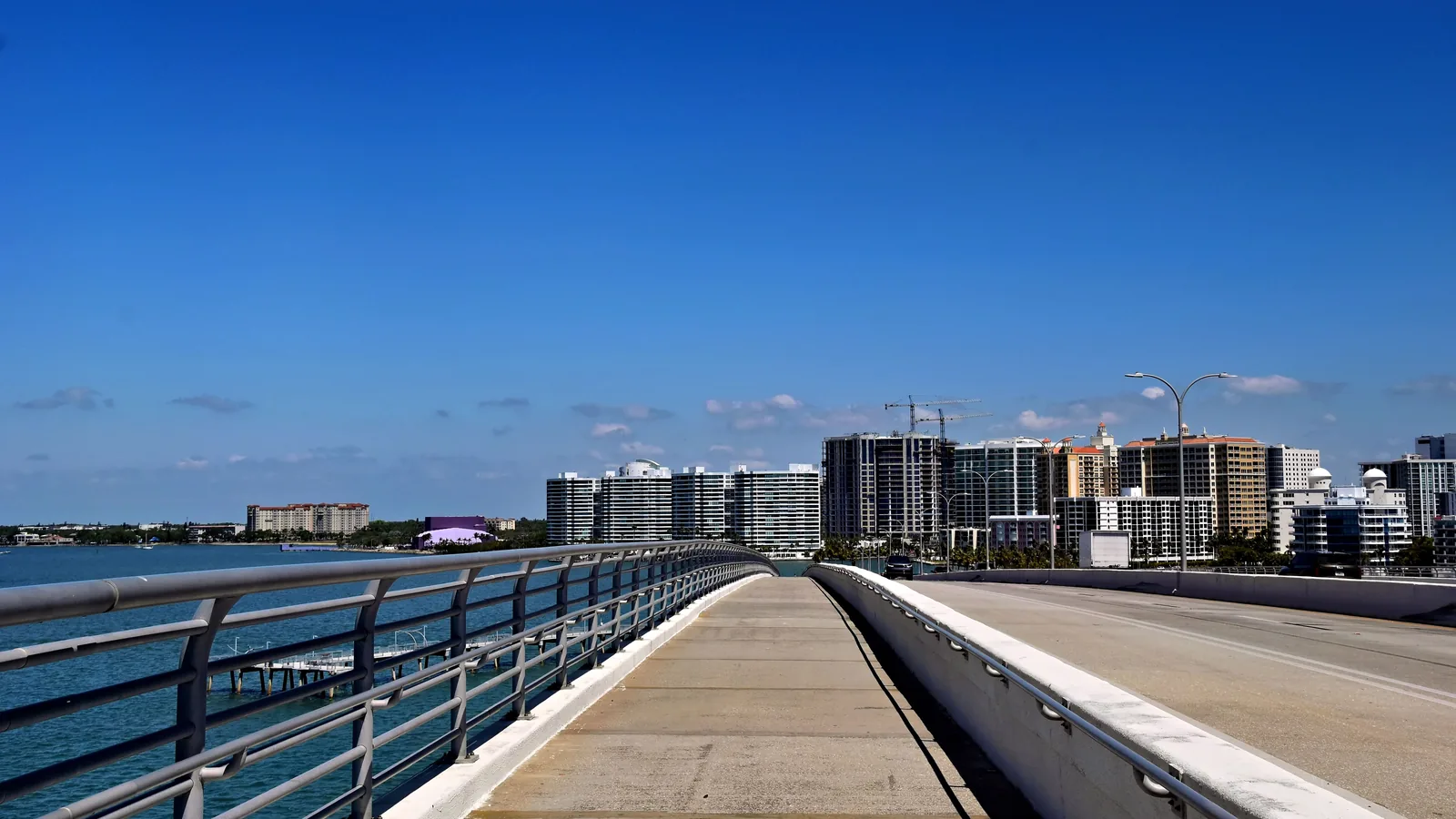
Waterfront condo balcony salt damage is a question of distance, and the scale is blocks rather than miles. Corrosion researchers put the marine effect at a few hundred meters from the shoreline, falling away quickly after that, so Beach Drive and Central Avenue at 16th Street are not on one schedule. Height is what owners get backwards: marine aerosol thins with altitude, so a high floor collects no more salt than a low one.
How far inland does salt actually reach?
A few hundred meters, then much less. A 2017 review of marine atmospheric corrosion puts the scale plainly.
However, for areas closest to the shoreline (~400 to 600 m), published data shows that the decrease in the corrosion rate with the distance from the sea is fairly well represented by a simple exponential relationship
Source: Morcillo, Chico, Alcántara and Díaz, Marine Atmospheric Corrosion of Carbon Steel (2017)The same review puts the marine effect at a few hundred meters from the shore, decaying rapidly inland. NASA measured the steep end at Kennedy Space Center: steel 45 meters from the Atlantic lost metal more than ten times as fast as steel 183 meters back. A downtown St. Petersburg block runs 100 to 130 meters, so the part of the curve that matters is three or four blocks wide.
What is different about a Beach Drive balcony?
Open water with nothing in front of it. Beach Drive NE at 2nd Avenue NE sits about 70 meters, 230 feet, from the seawall at the head of the yacht basin, and the air arriving there has crossed Tampa Bay rather than the city. That water is not brackish runoff: in the estuary program’s figures the lower bay runs 25 to 38 parts per thousand of salt, bracketing open-ocean seawater at about 35.
The National Weather Service defines a sea breeze as a daytime wind blowing off cool water onto warmer land, and its Tampa Bay office counts daily sea breezes among the drivers of the storm season here. What does not vary is that the first row of buildings has no filter in front of it, which the Beach Drive page covers building by building. A recurring plan exists for exactly that row of addresses.
What changes three blocks west?
Most of it. The walk west, measured from each place’s published coordinates to the downtown seawall:
| Address | From the seawall | What to expect |
|---|---|---|
| Beach Drive NE at 2nd Avenue NE | 70 m (230 ft) | Steady salt film; glass shows it first |
| North Straub Park | 90 m (295 ft) | The same band as Beach Drive |
| Central Avenue at 4th Street N | 640 m (0.4 mi) | Past the steep part of the curve |
| Crescent Lake Park | 900 m (0.56 mi) | Salt is no longer the main soil |
| Edge District, Central at 16th | 2.2 km (1.4 mi) | Dust, pollen and street grit dominate |
| Historic Kenwood | 3.8 km (2.3 mi) | An ordinary inland balcony |
Distances computed from OpenStreetMap coordinates to the seawall at Central Avenue’s latitude. Open bay begins about 600 m further east, so treat these as the short reading.
Text us your cross streets and we will tell you which band your balcony is in.
Text your addressThree blocks is 300 to 400 meters, still inside the steep band. The change is real, it happens fast, and it is mostly done by 4th Street.
Does the floor you live on matter?
Less than people think, and in the opposite direction to the usual assumption. The same review reports measurements up the side of a coastal building.
The concentration of marine aerosol decreases with altitude
Source: Morcillo, Chico, Alcántara and Díaz, Marine Atmospheric Corrosion of Carbon Steel (2017)The decline fits an exponential shaped by the wind: a twentieth-floor rail gathers no more salt than a third-floor rail in the same tower. What height changes is the wind, the rain reaching the surface, and how exposed the balcony is. The salt air guide left this open; this is the source that settles it.
Does the building itself shelter you?
Partly, and it cuts both ways. The review notes that structures in the airflow, forests and urban environments among them, cut the chloride reaching a surface, and cites a study that found a 34-fold gap between the most and least wind-protected points on one site.
The powder-coating maker AkzoNobel warns the other way. In its guidance a sheltered surface can be at more risk than an exposed one, since wind-blown salt lands there and rain never rinses it away.
Both hold at once: shelter cuts what arrives and removes what would have rinsed it off, so a recessed, roofed balcony inland can hold a film longer than an exposed one on the water. If yours never gets wet in a storm, treat it as closer in than the map says, and give it the hand method more often.
How should the schedule differ by address?
By distance first, exposure second. On the first blocks off the water a quarterly clean stops the film establishing; half a mile back, twice a year does, spring after the pollen and fall after the storms. The Tampa Bay calendar has those dates.
Address does not move the rate. It is $2 a square foot across St. Petersburg whether the balcony faces the bay or Kenwood, so where you live decides only how often the job is worth doing.
Measure the straight line east from your own address. Inside about 400 meters, plan on quarterly; past it, twice a year, and watch whatever the rain never reaches.
Frequently asked questions
Do waterfront balconies really need cleaning more often?
Yes, and the reason is measured rather than marketing: the marine effect concentrates within a few hundred meters of the shoreline. Quarterly suits the first blocks off the water, twice a year suits addresses a mile or more inland.
How far inland does salt air travel in St. Petersburg?
Far enough to reach every downtown address, but not evenly. Marine corrosion research describes the effect running a few hundred meters from the shore and decaying quickly, which is why the Edge District behaves differently from Beach Drive.
Do higher floors get more salt on the balcony?
It is the other way round. Marine aerosol concentration decreases with altitude, so a twentieth-floor balcony collects no more salt than a third-floor one in the same building. Exposure, and how much rain reaches the surface, matter more than the floor number.
Does a covered balcony stay cleaner?
It gets less salt and less rinsing. Structures in the airflow cut how much chloride reaches a surface, but coating makers warn that a sheltered surface can end up at more risk, because no rain arrives to wash off what does land.
Is Tampa Bay salty enough to matter?
It is genuinely marine. The estuary program’s salinity figures for the lower bay run from 25 to 38 parts per thousand, bracketing open-ocean seawater at about 35, so the air coming off it carries salt rather than fresh spray.
Sources
- Morcillo, Chico, Alcántara and Díaz. Marine Atmospheric Corrosion of Carbon Steel: A Review. Materials 10(4):406 (2017), hosted by the National Library of Medicine. pmc.ncbi.nlm.nih.gov
- NOAA National Weather Service. Glossary: sea breeze. weather.gov
- NOAA National Weather Service, Tampa Bay Area. Thunderstorm climatology quick reference. weather.gov
- Tampa Bay Estuary Program. About the Bay. tbep.org
- Montgomery, Pierre and McMullen, NASA Kennedy Space Center. Long-Term Corrosivity at KSC as a Function of Distance and Time from the Atlantic Ocean (2023). ntrs.nasa.gov
- AkzoNobel Interpon. Guidance Note 6: Cleaning and Maintenance of Powder Coated Architectural Components (2024). akzonobel.com
- OpenStreetMap contributors. Coordinates for the places in the distance table, and the downtown coastline. openstreetmap.org